
“If you go down in the woods today, You’re sure of a big surprise.” Admittedly, “The Teddy Bears Picnic” was probably never considered for a Grammy, but in one sentence it expresses what many of us feel as we walk or hike through our local forests.
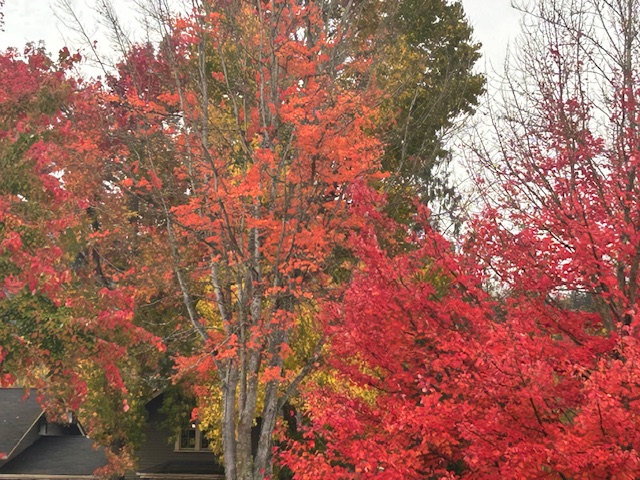
Lately, I’ve become obsessed with trees. They calm me and also create a feeling of awe. They’re a source of beauty and wonder, harbingers of changing seasons, possessors of fragrant scents, rainbows of color that alter with the seasons, and homes for birds, squirrels and other creatures.

Trees also have a lot to brag about. The oldest tree in the world is in California and is estimated to have lived for 4,858 years… so far. California also boasts the largest “single stem” tree on earth. The General Sherman Sequoia stands 275 feet tall with a base of 36 feet in diameter. The town of La Conner, WA has a cross section of an eight hundred year old Douglas Fir with tags stuck to different rings showing dates of events around the world starting with the Magna Carta in 1215.
Trees are good for us in many ways, most obviously in absorbing carbon dioxide and releasing oxygen. But what about psychological benefits?
The local botanical garden newsletter, “The Buzz,” has an article in its October edition on “The Healing Power of Nature,” by Jayce Grant.
Grant says, “Surveys show Americans spend about ten hours a day looking at screens, while the average time outdoors is just thirty minutes. But how much of those outdoor moments are spent running from the car to the store, mowing the lawn, or taking out the garbage for pickup. Time in nature maybe, or not.

Grant’s recommendation to escape this trend is to get outside and into the forest. She’s not the first to suggest this. The Japanese concept of “shinrin-yoku” or forest bathing has been around since 1982. This doesn’t refer to a literal bath but to immerse oneself in the colors, smells, and sounds of a forest.
And while the research can’t say conclusively that spending time in the woods will turn you into a picture of good health, one review of all the existing studies says, it helps reduce stress, lowers heart rate and blood pressure. And Chat GPT agrees.
Anyone who has tried forest bathing is aware of the benefits including exercise, fresh air, and the absence of screens and doomscrolling. It uses all the senses: scents from flowers; sounds of croaking by frogs, birdsongs, and the winds sailing through the trees; the touch of raindrops in the winter; and sights of birds, deer, and flowers. And we don’t need research to tell us we feel stronger, calmer, and relaxed – or worn out – after a walk through the woods.
As you immerse yourself in the forest, it’s best to ignore the rest of the lyrics to the teddy bear song.
“If you go down in the woods today,
You’d better not go alone.
It’s lovely down in the woods today,
But it’s safer to stay at home.”


 Still Life